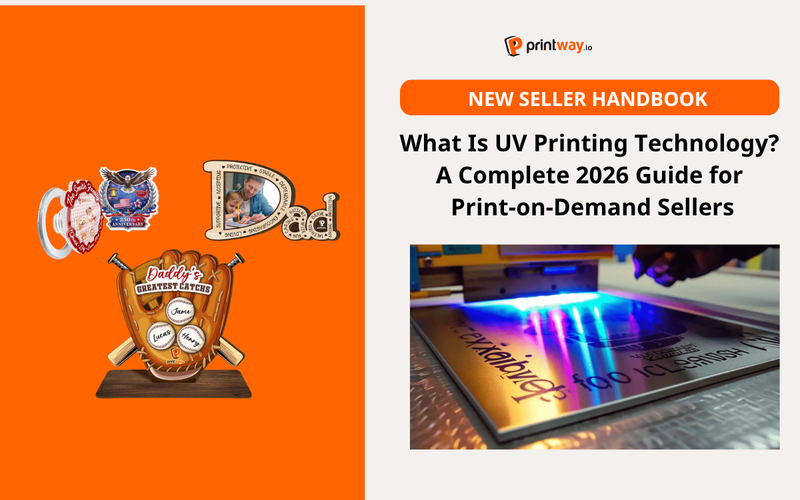
Printing has evolved faster in the last decade than in the previous century. From offset and screen printing to DTG and sublimation, each method solved a specific problem - but none offered the speed, versatility, and finish quality that today's ecommerce sellers demand. That is exactly where UV printing technology stepped in and quickly became the gold standard for premium print-on-demand products.
If you are researching what is UV printing technology, this guide walks you through the process, how it works, how it compares with screen printing and DTG, the products it is best suited for, and whether it is the right fit for your print-on-demand business.
What Is UV Printing?
UV printing is a digital printing technology that uses ultraviolet (UV) light to instantly cure - or dry - specially formulated inks as they are deposited onto a substrate. Unlike traditional printing, where inks dry through evaporation or absorption, UV inks remain on top of the material and harden in milliseconds when exposed to UV light.
The result is a print that is sharper, more vibrant, more durable, and compatible with a far wider range of materials than conventional printing methods can handle - from paper and plastic to wood, acrylic, metal, glass, ceramic, leather, and even stone.
Modern UV printers now overwhelmingly use UV LED lamps instead of older mercury-vapor lamps. UV LED technology is cooler, more energy-efficient, longer-lasting, and safer, making it the preferred choice for today's print-on-demand manufacturers, including Printway.
In short: UV printing technology is a fast, full-color, substrate-flexible digital printing process that produces professional-grade graphics on almost any flat or curved surface.
How UV Printing Works
Understanding the mechanics of UV printing helps you appreciate why it produces such a superior finish. The process happens in four tightly coordinated stages:
Substrate preparation. The material - wood, acrylic, metal, a tumbler, a phone case - is cleaned, sometimes primed, and loaded onto the printer bed. Flat UV printers use a vacuum bed to hold sheets in place, while rotary UV printers spin cylindrical items like tumblers or wine glasses.
Ink deposition. Printheads (typically piezoelectric) jet microscopic droplets of UV-reactive ink onto the surface. These inks contain pigments, monomers, oligomers, and photoinitiators. CMYK is standard, and premium UV printers add white and varnish channels for opacity on dark substrates and for gloss/spot effects.
Instant UV curing. As the printhead moves across the substrate, UV LED lamps mounted beside it emit ultraviolet light at specific wavelengths (usually 365–395 nm). The photoinitiators in the ink react to the UV light and trigger polymerization - a chemical reaction that instantly hardens the ink into a solid, durable layer.
Finishing. Because the ink cures on contact, finished products come off the printer ready to handle, pack, or ship. There is no drying rack, no offset powder, and no VOC off-gassing period.
This immediate cure is the superpower of UV printing technology: it eliminates smudging, absorption, and bleed, which is why UV-printed graphics look razor-sharp even on non-porous materials like glass or metal.
Benefits of UV Printing
UV printing has become the default for premium POD products for a reason. Here are the concrete advantages that matter most to ecommerce sellers.
Exceptional color vibrancy and detail. Because UV ink sits on top of the substrate rather than soaking in, colors stay saturated and edges stay crisp. Fine text, gradients, and photo-realistic artwork reproduce faithfully.
Instant drying, faster fulfillment. UV-cured prints are touch-dry the moment they leave the printer, meaning faster production times and shorter turnaround for your customers - a major SEO and conversion advantage on marketplaces like Etsy and Amazon, where shipping speed influences rankings.
Unmatched material versatility. UV printing works on wood, acrylic, metal (aluminum, stainless steel), glass, ceramic, leather, canvas, plastic, stone, and more. This opens up product categories that DTG, sublimation, or screen printing simply cannot serve.
Outstanding durability. Cured UV ink is resistant to scratching, fading, water, UV light, and most household chemicals. Products retain their finish through dishwashers, outdoor exposure, and daily handling.
Eco-friendlier than solvent printing. UV inks emit minimal to no volatile organic compounds (VOCs), reduce ink waste, and, with LED lamps, consume far less energy than mercury-vapor systems. That makes it easier to market your products as sustainably produced.
Textured and tactile effects. By layering ink and varnish, UV printers can create raised textures, Braille effects, gloss spots, and simulated embossing - a premium feel without the cost of foil stamping or debossing.
Lower long-term costs. UV LED lamps last tens of thousands of hours, and minimal setup means short-run and one-off orders are just as economical as large batches. That is exactly what the POD model needs.
Choosing between printing technologies depends on what you are selling. Here is how UV printing compares with two of the most common alternatives in the print-on-demand world.
UV vs Screen Printing
Screen printing pushes ink through a mesh stencil, one color at a time, and is the traditional workhorse for bulk apparel.
Color and detail. UV printing produces full-color, photo-quality images in a single pass. Screen printing is limited to solid-color designs and becomes expensive as color counts rise.
Setup costs. Screen printing requires a separate screen per color, making short runs and one-off custom designs uneconomical. UV printing has zero setup - ideal for POD's made-to-order model.
Substrate range. Screen printing is optimized for fabric, paper, and some plastics. UV printing handles rigid and irregular surfaces - wood, metal, acrylic, glass - that screen printing struggles with.
Turnaround. UV prints come off the bed dry and ready. Screen prints require drying or curing time per color layer.
Best use case. Choose screen printing for very high-volume apparel runs with one to four colors. Choose UV printing for full-color, low-to-mid-volume, or multi-material POD catalogs.
UV vs DTG
DTG (direct-to-garment) is essentially inkjet printing onto fabric using water-based inks.
Material compatibility. DTG is strictly for textiles, mostly cotton or cotton-heavy blends. UV printing covers textiles and hard goods like tumblers, signs, ornaments, and phone cases.
Durability. UV-cured prints are more resistant to scratching and wear on hard surfaces. DTG prints on cotton can fade over repeated washes, even with proper pretreatment.
Feel on fabric. DTG has a soft hand because ink absorbs into fibers. UV-printed fabric is less common and typically has a slightly raised, sealed feel - better suited to accessories like canvas bags, patches, or leather goods than to soft-touch t-shirts.
Speed. Both are digital and on-demand-friendly. UV is generally faster per unit because there is no pretreatment or post-cure bake.
Best use case. Use DTG when your niche is premium soft-hand cotton apparel. Use UV printing when your catalog spans home decor, drinkware, ornaments, and accessories - in other words, most POD brands scaling beyond t-shirts.
What Products Use UV Printing
UV printing technology unlocks one of the widest product catalogs in print-on-demand. If it is flat, curved, rigid, or textured, chances are you can print on it. Common UV-printed products include:
Apparel accessories: canvas tote bags, leather patches, caps with rigid fronts, backpacks, and wallets.
Drinkware: stainless steel tumblers, skinny tumblers, wine tumblers, mugs, water bottles, and thermos flasks.
Home decor: wooden signs, metal signs, acrylic plaques, canvas prints, coasters, and cutting boards.
Ornaments and seasonal items: ceramic and wooden Christmas ornaments, Easter eggs, Halloween buckets, and memorial keepsakes.
Tech accessories: phone cases, laptop sleeves, tablet covers, custom keyboards, mouse pads, and pop sockets.
Stationery: notebooks, journals, pens, bookmarks, and planner covers.
Lighting and home accents: lamp shades, candle holders, lanterns, switch plates, and picture frames.
Promotional and B2B: branded signage, trade-show displays, product prototypes, and ID cards.
Because UV printing handles both flexible and rigid materials, it is the single most scalable technology for a POD catalog that wants to grow beyond apparel.
Is UV Printing Right for Your Business?
UV printing is powerful, but it is not the right fit for every POD brand. Use this quick decision framework.
Choose UV printing if:
Your niche focuses on home decor, drinkware, ornaments, personalized gifts, or accessories.
You want to sell across multiple materials (wood, acrylic, metal, ceramic) without switching suppliers.
You need photo-quality, full-color designs with fine text or gradients.
You prioritize durability - items that must survive dishwashers, outdoor use, or daily handling.
You run a lean, made-to-order operation where setup-free digital printing keeps unit economics healthy.
You sell in cross-border ecommerce and want premium-feeling products that justify higher price points in Western and Asian markets.
Consider alternatives if:
Your entire catalog is soft cotton apparel → DTG or screen printing typically wins on feel.
You print extremely high volumes of 1–3 color designs on t-shirts → screen printing is more cost-efficient at scale.
Your core product is all-over-print polyester apparel → sublimation is the better match.
For most scaling POD sellers, especially those expanding into gifting, home, and personalization niches, UV printing technology is the most versatile engine to build a catalog around.
Best Print-on-Demand Products Using UV Printing at Printway
At Printway, UV printing powers the majority of our best-selling home decor, drinkware, and ornament categories. All products are manufactured in Vietnam using UV LED technology for consistent quality, fast fulfillment, and worldwide shipping.
20oz Stainless Steel Tumbler- double-walled SUS 304 steel, vacuum-insulated, UV-printed with a fade-resistant finish. Base cost from $7.73.
20Oz Skinny Tumbler- sleek profile, slip-resistant grip, microwave- and dishwasher-safe. Base cost from $7.31.
12 Oz Wine Tumbler - compact, giftable, premium feel. Base cost from $6.61.
Each Printway Tumbler is made from SUS 304 metal and the lid is made of premium materials. Double-walled insulated mugs with a vacuum in the middle keep your drinks warm for 3 to 4 hours. A durable UV finish that won't fade, peel or crack with long-term use and also provides extra grip.
Home Decor products on materials such as wood, metal, or acrylic at Printway all use optimal UV printing technology.
Take a look at our best-selling Home Decor products:
Printed Metal Sign: The sign is made of metal to ensure the product is durable. With 4 pre-drilled holes and 4 rounded corners make it is easy to hang anywhere
Round Wooden Sign: The product is made of plywood, non-toxic, odorless, exquisite craft and fashion design with 5mm thickness. You can customize the design to suit your purposes
Rectangle Wooden Sign: Made of high-quality 0.31" thick plywood. They are durable. Used for many years.
Custom wooden Sign: The product is made of pressed wood, non-toxic, odorless, exquisite craft and fashion design with a thickness of 5mm. You can customize what design suits your purpose.
Acrylic Plaque: Acrylic Plaque uses Acrylic glass material with Acrylic legs, the print is extremely clear, vivid, and easy to customize with any image and message. Size: the product has 2 sizes: 4x6 inches, and 6x8 inches. Easy customization with all images and text on one side.
FAQs
What is UV printing technology in simple terms? UV printing technology is a digital printing method that uses ultraviolet light to instantly dry specially formulated inks as they hit the material. This produces vibrant, durable prints on almost any surface.
Is UV printing better than sublimation? They serve different purposes. Sublimation is best for all-over-print polyester apparel and some coated hard goods. UV printing is better for wood, acrylic, metal, glass, ceramic, and mixed-material catalogs.
How durable is UV printing? Very durable. UV-cured prints resist scratching, water, UV light, and most household chemicals. On tumblers and signs, prints typically last the full lifespan of the product with normal use.
Is UV printing safe? Yes. Modern UV LED printers are fully enclosed and safe to operate. Cured UV inks are inert, food-contact-safe versions are available for drinkware, and VOC emissions are minimal compared to solvent printing.
Can UV printing be done on t-shirts? UV printing can be applied to some textiles, but it is not the standard for soft cotton apparel. For t-shirts and hoodies, DTG or screen printing typically delivers a better hand-feel.
How long does a UV print take to dry? It dries instantly - typically in milliseconds under the UV LED lamp. The product can be handled and packed immediately.
Is UV printing eco-friendly? UV printing emits minimal VOCs, uses less energy with LED lamps, and produces little ink waste, making it one of the more sustainable digital printing options available today.
What is the best UV printing supplier for print-on-demand sellers? Printway offers a full UV-printed POD catalog - drinkware, ornaments, wooden signs, metal signs, and acrylic plaques - manufactured in Vietnam with worldwide fulfillment.
Wrapping Up
UV printing technology has quickly become the backbone of modern print-on-demand. Its combination of photo-quality output, material flexibility, durability, and environmental benefits makes it ideal for sellers who want to build a diverse, premium catalog without juggling multiple production methods.
If you are planning to sell high-margin, high-quality UV-printed products, Printwaycan fulfill your entire catalog - from tumblers and ornaments to wooden and metal signs - while handling printing, packing, and shipping for you.
Ready to scale with UV printing? Leave us a message for a product walkthrough, or join our community for the latest POD trends, SEO insights, and ecommerce growth tips.
Written by
Hanh HoangHanh Hoang is a marketing leader at Printway, with 4+ years of hands-on experience in Print-on-Demand, eCommerce marketing, and cross-border selling. She works closely with POD sellers to optimize product strategies, customer experience, and growth performance.
If you’re looking for practical insights and proven strategies to run and scale a successful eCommerce business, explore Hanh’s articles on Printway’s blog, where real-world experience meets actionable guidance.