
Hanh Hoang
May 11 2026 •8 minutes
An abandoned cart is one of the largest sources of lost revenue in e-commerce - and one of the most recoverable. This guide breaks down what an abandoned cart actually is, why it happens, how recovery works in 2026, and the seven tactics that consistently win back the most revenue for cross-border online sellers.
Quick answer: An abandoned cart is an online shopping session where a customer adds one or more products to the cart but leaves the site before completing the purchase. The average e-commerce cart abandonment rate, according to the Baymard Institute, is roughly 70%.
An abandoned cart is an online shopping session in which a customer adds one or more products to their cart and then exits the site without completing checkout. The Baymard Institute, which has tracked checkout behavior since 2010, places the average documented cart abandonment rate at roughly 70% - meaning seven out of every ten carts started never become orders.
For cross-border sellers - including print-on-demand stores selling through Etsy, Shopify, Amazon, or WooCommerce - abandoned carts represent more than missed revenue. Each abandoned cart points to a specific friction in the buying journey. Once that friction is fixed, conversion improves not just for the single recovered shopper, but for every future customer who reaches the same step.
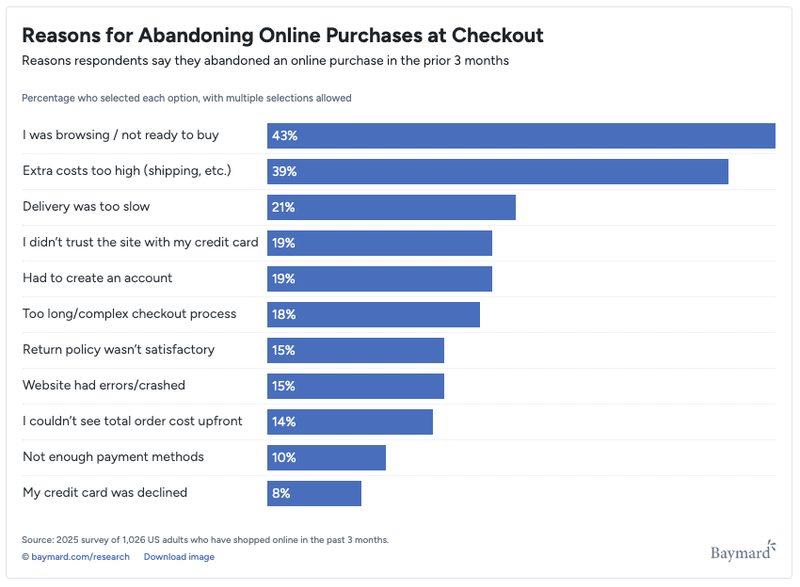
Most abandoned carts trace back to a small set of recurring causes. Excluding shoppers who were "just browsing," Baymard's long-running checkout studies consistently identify the following as the top reasons:
For sellers shipping internationally, three causes hit disproportionately hard:
Abandoned cart recovery is the set of tactics a seller uses to bring shoppers back to a cart they left behind and convert them into paying customers. A modern recovery program combines four channels: triggered emails, paid retargeting ads, on-site interventions (exit-intent popups, returning-visitor banners), and - increasingly in 2026 - SMS or push notifications on apps.
A well-built recovery program does more than chase a single shopper. It feeds the next round of conversion-rate optimization by surfacing exactly which step in checkout is breaking trust, which payment method is missing, or which shipping promise is failing.
Recovery runs on three components: a trigger, a channel, and a timing rule.
The storefront platforms themselves - Shopify, WooCommerce, Etsy (limited), Amazon (very limited) - expose abandoned cart events differently. Marketing platforms such as Klaviyo, Avada, Omnisend, and Mailchimp listen for the trigger and run the channel logic on top of it.
The headline figure - "70% of carts are abandoned" - is also the recovery opportunity. Very few stores recapture all of it; the strongest recover 10–30% of abandoned carts back into orders. The seven tactics below stack: each one removes a specific friction or adds a specific nudge, and combined they consistently outperform any single tactic in isolation.
Unexpected shipping cost is the single most common cause of cart abandonment in every published study since 2016. Shoppers do not necessarily expect free shipping - they expect predictable shipping. Three ways to defuse the cost surprise:
Trust collapses fastest at the payment step. Shoppers on cross-border stores need explicit visual cues: payment-processor logos, an SSL badge, recognizable wallet options (Apple Pay, Google Pay, PayPal), and clear refund language near the buy button. In 2026, supporting modern alternative payments - buy-now-pay-later providers, regional wallets in EU and APAC - is table stakes for high-conversion stores.
If a shopper sees only an unfamiliar payment form on the final step, expect a step-change drop in completion.
Forcing shoppers to create an account before checkout remains one of the top three abandonment reasons. Offer guest checkout - full stop. You can still collect an email for the receipt and future marketing without making account creation a wall. Account creation should be optional and incentivized ("save your details for faster checkout next time"), never required.
You do not have to build cart recovery from scratch. Tools like Avada, Klaviyo, Omnisend, Mailchimp, and ActiveCampaign listen for the abandoned-cart event from your storefront and run multi-channel flows automatically. Choose a tool that:
For sellers fulfilling through Printway, the recovery tool only needs cart events from the storefront - fulfillment runs in parallel, so the recovery flow does not change when you add Printway as your fulfillment partner.
An abandoned cart email is an automated message sent to a shopper who added items to their cart and left without purchasing. It is the single highest-ROI message in most e-commerce email programs: industry benchmarks regularly show open rates above 40% and recovery-flow conversion rates of 5–15%.
A strong abandoned cart email sequence usually follows this rhythm:
Every email should link directly back to the populated cart - not the homepage - and should be mobile-first in layout. Personalize beyond first name: show the actual product image, name, and price the shopper left behind.
Email alone misses shoppers who never identified themselves. Abandoned cart retargeting uses paid ads on Meta, Google, and TikTok to re-show the abandoned product to anonymous shoppers using pixel data. Best practice in 2026:
For stores spending under $1,000 per month on ads, prioritize email recovery first; for stores spending more, run cart retargeting in parallel with the email sequence.
The strongest recovery program is the one you barely need. Every percentage point of friction removed from the live checkout flow is permanent - unlike a recovery message that only catches one shopper at a time. Focus areas:
A 1-point improvement in checkout completion is worth more than a 10-point lift in recovery email open rate - and it compounds across every future shopper, not just the ones already lost.
>>> Discover how to make money with print-on-demand and grow your POD business effectively.
Abandoned carts are not a leak to seal. They are a feedback channel that tells you exactly where shoppers lose confidence, and they are the most recoverable source of revenue in any e-commerce business. The stores that win in 2026 are not the ones that send the most aggressive recovery emails - they are the ones that fix the underlying friction first, then use a layered recovery program to catch the shoppers who still slip through.
For cross-border sellers, the combination is especially powerful: a clean, trustworthy checkout on your storefront paired with reliable, tracked fulfillment from the moment the order is placed. The trust you build at checkout is the trust your fulfillment partner has to keep.
Ready to reduce delivery-anxiety abandonment? Connect your Etsy, Shopify, Amazon, or WooCommerce store to Printway and give every order the production speed, factory routing, and tracking visibility cross-border buyers expect in 2026.
What is an abandoned cart? An abandoned cart is an online shopping session in which a customer adds items to their cart and exits the site before completing checkout. Industry data places the average cart abandonment rate around 70% across e-commerce.
What is abandoned cart recovery? Abandoned cart recovery is the practice of bringing back shoppers who left items in their cart using triggered emails, paid retargeting ads, on-site interventions, and SMS or push messages.
What is an abandoned cart email? An abandoned cart email is an automated message sent to a shopper who left items in their cart without purchasing. A typical recovery sequence sends three emails over 72 hours - a reminder, social proof, and a time-bound incentive.
How much revenue can abandoned cart recovery realistically recover? Most stores recover 10–30% of abandoned carts when running a layered program (email + retargeting + on-site). The exact figure depends on traffic source, product price, and how much existing friction can be removed at checkout.
When should the first abandoned cart email be sent? The strongest first message lands within 60 minutes of abandonment, while the shopper still remembers their intent. The 24-hour and 48–72-hour follow-ups complete the standard three-message sequence.