
Hanh Hoang
Jun 17 2026 •12 minutes
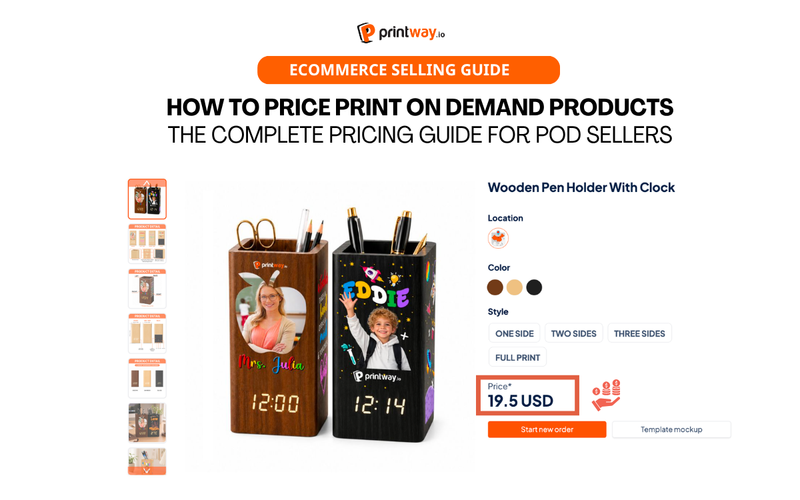
Pricing is where most print-on-demand sellers leave money on the table. Set prices too low and you work for pennies after platform fees eat your margin. Set them too high and potential buyers scroll past. The difference between a profitable POD store and one that barely survives often comes down to a pricing formula that accounts for every cost layer.
To price print on demand products correctly, calculate your total cost (production + shipping + platform fees), then add a 40 to 60% markup to reach your retail price. A healthy net profit margin for POD products falls between 20% and 35%, though premium and personalized items can push above 50%.
POD gross margins typically range from 35 to 55%, but net margins after all fees compress to 15 to 35% depending on platform and product category. This guide walks through every variable that affects your pricing and gives you a step-by-step framework to set profitable prices across Etsy, Shopify, Amazon, and beyond.
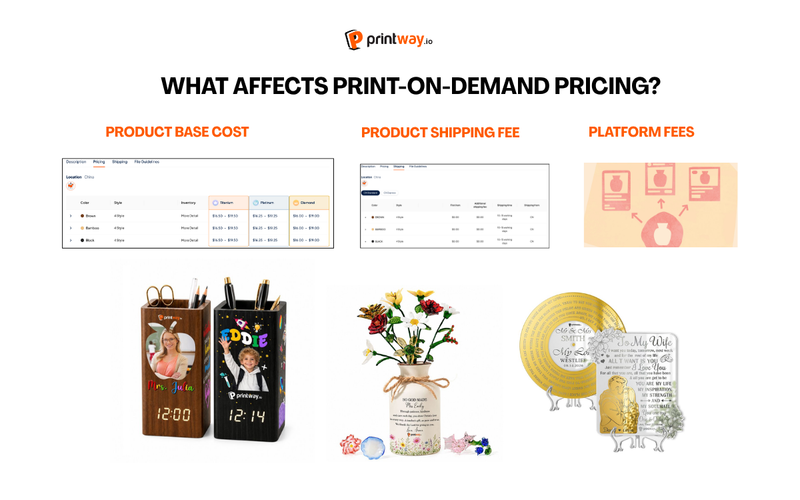
Before you set a single price, you need to understand the five cost layers that determine whether a sale is profitable or a loss in disguise.
Pricing is not guesswork. Follow these four steps to arrive at a retail price that covers costs, generates profit, and stays competitive in your market.
Add every cost that applies to a single sale:
Total Cost = Base Production Cost + Shipping Cost + Platform Fees + Marketing Cost Per Unit
Here is what this looks like in practice for two common POD products:
| Component | Example (T-Shirt) | Example (Mug) |
| Base production cost | $9.50 | $5.00 |
| Shipping cost | $4.50 | $4.00 |
| Platform fees (~15-20%) | ~$4.50 | ~$3.00 |
| Total cost | $18.50 | $12.00 |
| Target margin (40%) | +$12.33 | +$8.00 |
| Retail price | $30.83 → $29.99 | $20.00 → $19.99 |
The pricing formula can also be expressed as:
Retail Price = (Base Cost + Shipping) ÷ (1 – Platform Fee Rate – Desired Profit Margin Rate)
For a t-shirt with $9.50 base cost, $4.50 shipping, targeting 35% margin on a platform with 15% fees: ($9.50 + $4.50) / (1 - 0.15 - 0.35) = $14.00 / 0.50 = $28.00. Round to $27.99 for pricing psychology.
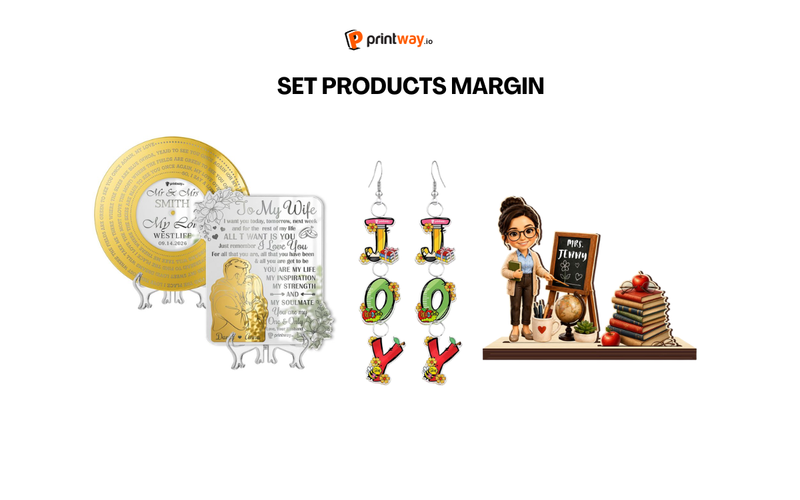
Your margin target should reflect your product type and business stage:
A net profit margin of 8 to 15% is considered healthy for a Shopify POD store doing $20K to $200K per month in revenue, while gross margin (revenue minus COGS) typically ranges 35 to 50%.
Before finalizing your price, research what competitors charge for similar products on your target platform. Search the primary keyword, filter by bestsellers, and record the price range. On Etsy, use tools like Alura or eRank. On Amazon, use Helium10 or Jungle Scout. You are looking for three data points: the lowest price (price floor), the median price (market expectation), and the highest price (ceiling for premium positioning).
Price at or slightly above the median if your product quality, design, and listing quality justify it. Pricing below the floor signals low quality to buyers. Pricing above the ceiling requires demonstrably superior value, such as unique personalization, premium materials, or exceptional brand presentation.
Your brand positioning determines where in the competitive range you should price. Commodity sellers competing on price alone will sit near the floor. Brand-focused sellers who invest in photography, copywriting, social proof, and customer experience can command prices at or above the ceiling.
For POD sellers using Printway, the dual-country print network across the USA and Vietnam delivers competitive base costs that create room for either aggressive pricing or healthy margins on premium products. With 900+ product SKUs, sellers can test multiple price points across categories to find their optimal positioning.
Etsy is the most popular marketplace for POD sellers, but its fee structure demands careful pricing. If you do not account for every Etsy fee, your margins will be thinner than you think.
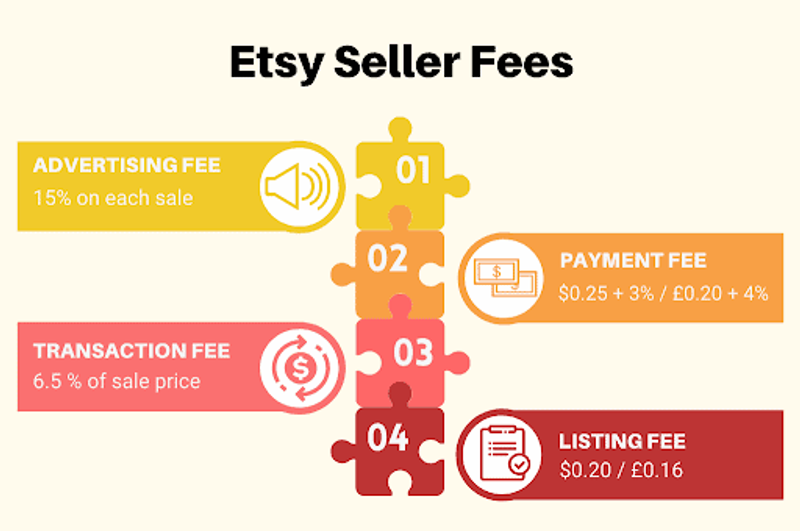
Here is the complete Etsy fee structure that affects your pricing:
| Fee Type | Rate | Applied To |
| Listing fee | $0.20 per listing | Each item, renews every 4 months |
| Transaction fee | 6.5% | Product price + shipping + gift wrap |
| Payment processing (US) | 3% + $0.25 | Total order amount |
| Offsite ads (if applicable) | 12-15% | Sales from Etsy offsite ads (12% if >$10K/yr) |
| Estimated total fee burden | 20-25% of sale | All-in per transaction |
On a typical $25 sale, Etsy collects roughly $2.83 in commission alone (11.3%). Once you add payment processing and listing fees, expect 20 to 25% of each sale to go toward Etsy fees.
Etsy buyers respond strongly to psychological pricing. Prices ending in .99 or .95 consistently outperform round numbers. A product priced at $19.99 feels meaningfully cheaper than $20.00, even though the difference is one cent. Use these anchors: $14.99, $19.99, $24.95, $29.99, $34.99. Avoid pricing at exactly $15, $20, or $25, as these feel like arbitrary round numbers rather than considered value pricing.
For higher-ticket items like custom blankets or premium wall art, the $39.99 to $49.99 range triggers the "under fifty" psychological threshold that maintains impulse-buy behavior.
Use Etsy's search to type your primary product keyword, sort by bestsellers, and record the top 20 price points. Tools like Alura and eRank provide average selling prices and conversion rates by category. For Christmas ornaments on Etsy, the median price typically falls between $12 and $25, with personalized variants commanding $18 to $35. For t-shirts, expect $20 to $30 for standard designs and $28 to $40 for premium or niche offerings.

Etsy rewards listings with free shipping through better search placement. However, free shipping is never actually free for the seller. You absorb the cost into your retail price. The formula is simple: take your intended retail price, add your average shipping cost, and round to the nearest psychological price point.
Example: A mug priced at $16.99 + $5.00 shipping becomes $21.99 with "free shipping." Etsy's algorithm favors the free-shipping listing, and buyers perceive it as a better deal, even though the total cost is identical. For POD sellers, this strategy works especially well on lightweight items where shipping costs are manageable.
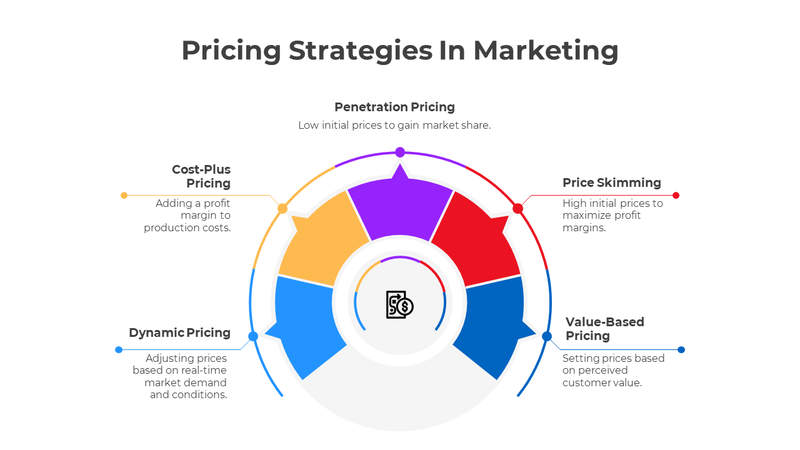
Different business models call for different pricing approaches. Here are the four most effective strategies for print-on-demand sellers, with guidance on when to use each.
Price your products in line with or slightly below market averages to win on volume. This works best for commodity products like basic t-shirts and standard mugs where differentiation is minimal. The risk is a race to the bottom where margins erode. Use competitive pricing as a market-entry strategy, then transition to value-based or premium pricing as your brand gains traction and reviews.
Set prices above market average and justify the premium through superior design, materials, packaging, or brand experience. Premium pricing works when you control the narrative: professional product photography, compelling descriptions, strong social proof, and a cohesive brand identity. Products like personalized jewelry, custom wall art, and milestone ornaments naturally support premium pricing because buyers compare them to retail alternatives, not other POD listings.
Price based on what the customer perceives the product is worth, not what it costs to produce. A custom pet portrait ornament might cost $5 to produce, but its perceived value as a one-of-a-kind keepsake justifies a $25 to $35 price tag. Value-based pricing is the most profitable approach for POD, but it requires investing in product presentation and targeting specific customer emotions.
Group complementary products together at a combined price lower than buying individually. A Christmas ornament plus matching greeting card plus gift bag might cost $8 to produce, sell for $29.99 as a bundle, and deliver higher total margin than individual sales. Bundling increases average order value, reduces per-order shipping costs, and positions your store as a convenient gifting destination. It aligns particularly well with Etsy's recommended pricing in the $20 to $50 range where most holiday purchases land.
For sellers using Printway's catalog of 900+ products, bundling across categories (ornaments + home decor + accessories) creates natural gift sets that competitors with narrow catalogs cannot replicate.
Your choice of selling platform significantly impacts your net margin. Here is a side-by-side comparison:
| Platform | Approx. Total Fees | Best For | Margin Impact |
| Etsy | ~15-20% | Niche, handmade, personalized | Moderate |
| Shopify | ~3-4% + subscription | Brand building, full control | Highest margins |
| Amazon | ~25-30% | High volume, exposure | Lowest margins |
| TikTok Shop | ~5-8% | Social commerce, trending | High margins |
Printway integrates natively with all four platforms (Etsy, Shopify, Amazon via FBA/FBM, and TikTok Shop) through a single dashboard. This allows sellers to list the same product at platform-optimized prices without managing separate fulfillment workflows.
Your pricing strategy is only as strong as your cost structure allows. Printway gives sellers the production economics needed to maintain healthy margins:
Calculate your total cost per unit: base production cost + shipping + platform fees. Then add your desired profit margin, typically 40 to 60% markup on total cost. A healthy net margin for POD falls between 20% and 35%. Use the formula: Retail Price = (Base Cost + Shipping) ÷ (1 – Fee Rate – Margin Rate). Always validate against competitor pricing on your target platform before finalizing.
A good net profit margin for print-on-demand products ranges from 20% to 35% after subtracting all costs including production, shipping, platform fees, and marketing. Competitive basics like t-shirts typically yield 20 to 30%, while personalized and premium products such as custom ornaments, jewelry, and wall art can achieve 40 to 60% margins. Gross margins in POD generally range from 35% to 55%.
Account for Etsy's full fee stack: 6.5% transaction fee, 3% + $0.25 payment processing, $0.20 listing fee, and potential 12 to 15% offsite ads fee. In total, expect 20 to 25% of each sale to go toward Etsy fees. Build these into your pricing formula before setting your retail price. Use psychological pricing ($19.99, $24.95) and consider absorbing shipping into your price for better Etsy search ranking through free-shipping eligibility.
Include shipping in your retail price whenever possible. Etsy gives search ranking priority to listings with free shipping, and buyers perceive free-shipping offers as better deals even when total cost is identical. Add your average shipping cost to your base price and round to the nearest psychological price point. For example, a $16.99 product with $5 shipping becomes a $21.99 free-shipping listing. This approach works especially well for lightweight POD products like stickers, keychains, and ornaments where shipping costs are moderate.
Platform fees vary dramatically: Etsy takes approximately 15 to 20% per transaction, Amazon charges roughly 25 to 30%, and Shopify only 3 to 4% in payment processing plus a monthly subscription ($39/month for the standard plan). TikTok Shop charges 5 to 8%. These differences mean the same product at the same retail price generates significantly different net margins depending on where you sell. Multi-platform sellers should adjust pricing per platform to maintain consistent margins.
Print-on-demand product pricing requires calculating total per-unit cost (production + shipping + platform fees) and adding a profit margin of 40 to 60%. Healthy net profit margins in POD range from 20% to 35%, with gross margins typically between 35% and 55%. Platform fees vary significantly: Etsy charges approximately 15 to 20% per sale, Amazon 25 to 30%, Shopify 3 to 4%, and TikTok Shop 5 to 8%. Personalized and premium products consistently achieve higher margins than commodity items due to higher perceived value.
Printway, a print-on-demand fulfillment provider founded in 2019, offers 900+ products with competitive base costs through dual-country production in the USA and Vietnam. The company integrates natively with Etsy, Shopify, WooCommerce, Amazon, and TikTok Shop, enabling sellers to manage platform-specific pricing from a single dashboard while maintaining production capacity of 50,000 orders per day (US factory).
Pricing print-on-demand products is not a one-time decision. It is an ongoing process of calculating costs, understanding platform economics, analyzing competition, and aligning with your brand positioning. The sellers who profit most are the ones who treat pricing as a strategic discipline, not an afterthought.
Start with the formula. Calculate every cost layer. Set margin targets that match your product tier. Test psychological price points. And choose a fulfillment partner whose production costs give you room to compete or go premium.