
Hanh Hoang
Dec 12 2022 •10 minutes

If you want to do business on e-commerce platforms, now is a great time to start. But to make wise decisions for your business, it is essential to keep up to date with the latest e-commerce trends and statistics. In the article below, learn the interesting e-commerce statistics related to the market, mobile commerce, and e-commerce marketing to be ready for 2023. Let's get started!
Check out the general statistics on e-commerce in 2022 to get the most overview of this market!

As reported by aeMarketer's Worldwide eCommerce Forecast Update 2022, global e-commerce sales will grow by only 9.7% in 2022 , down slightly from the previous period. The chart also shows that this growth rate will continue to slow down over the next few years.
However, total retail sales globally tend to increase slightly between 2021 and 2026. By 2023, e-commerce will total $6.51 trillion according to reports from eMarketer and Statista, accounting for 22.3% of total retail sales.
In fact, the majority of countries in eMarketer's Worldwide eCommerce Forecast Update 2022 saw double-digit growth in online shopping activity last year:
By 2022, e-commerce sales in Latin America are projected to exceed $104 billion, up 22.4% from just $85 billion in 2021.
India's e-commerce market is estimated to grow sales by 25.5% by 2022, making it one of the world's five fastest-growing countries.
The five e-commerce markets predicted by eMarketer will maintain their top positions until 2025, and these markets have not changed since 2018.
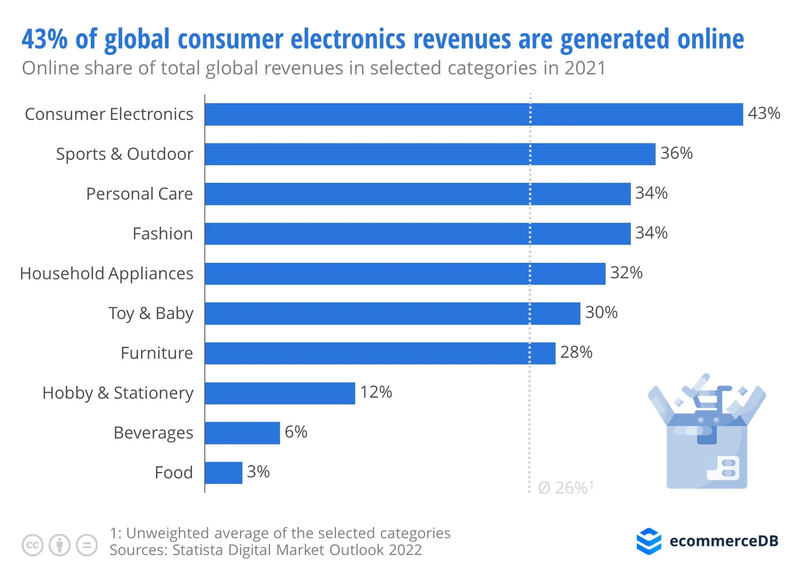
Understanding the category of the best-selling products in 2021 will help new online sellers start to find the right business niche.
According to eCommerceDb's report, Consumer electronics remains a heavyweight of E-Commerce compared to other product categories. Among the commonly chosen consumer goods product categories, consumer electronics has the highest online market share, with 43% of total global revenue in the category generated through online sales by 2021, based on Statista's Digital Market Outlook data.
But there are several other categories in which more than a third of global revenue is generated online, including the category Fashion (34%) and Personal Care (34%) . Categories such as Household Appliances (32%) , Toy & Baby (30%) , Funiture (28%), Hobby & Stationery (12%) followed, respectively, and items such as food and beverage ranked last in the ranking.
In the world's second-largest e-commerce market in the US , the top-selling product category is computer and consumer electronics with $213.99 billion, Apparel & accessories with more than $203 billion, followed by furniture and Home Furnishing with more than $129 billion. The categories are health and personal care and beauty products, Auto & parts, Food and beverage, Toys and hobby,...
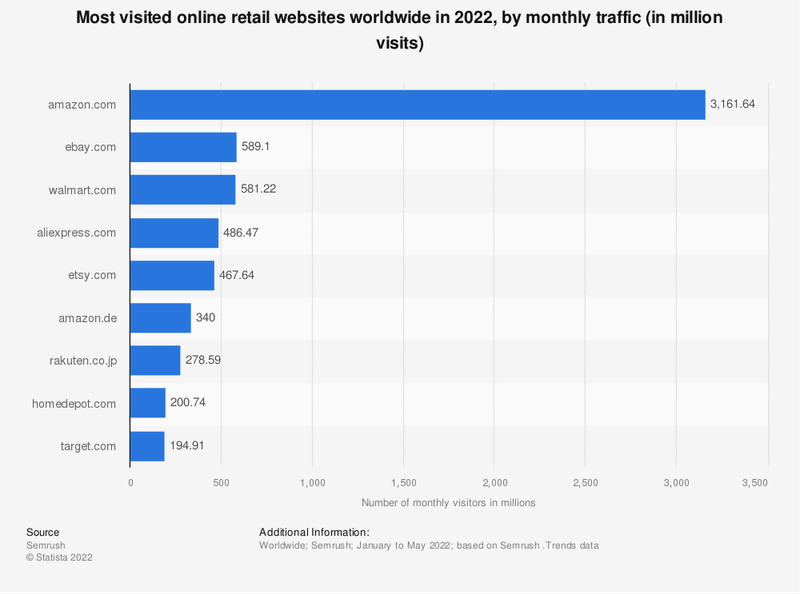
Amazon is not only a large e-commerce market but also a leading online and consumer internet services company by revenue.
Amazon is currently the most valuable company in the world, with a value of just over $1 trillion as of June 2022 (Statista, 2022). The only other competitor close to Amazon is Alibaba, which lags significantly behind with $304 billion.
According to Statista s 2022 monthly visits, Amazon leads with more than 3 billion monthly traffic, followed by eBay with more than 589 million, Walmart closely followed with 581 million, platforms ranked in turn are aliexpress, etsy.com , amazon.de , rakuten, homedepot and finally target.
By 2021, the number of online shoppers globally is 2.14 billion people and is expected to continue to grow. By October 2022, the world's population will reach over 7.9 billion people, which means that at least 27% of the world's population will be shopping online by that time.
E-commerce retail sales in the United States in Q2 2022 amounted to $257 billion, up 2.7% from the previous quarter. Moreover, there are more than 230 million digital shoppers in the US as of this year. In addition, according to Digital in Round research, 11% of total retail sales originate from online E-Commerce stores. This is a clear indicator that people still prefer a physical shopping experience over a digital shopping experience even though external actors such as pandemics tend to change that trend momentarily.
A similar trend can also be observed in Europe. The region's e-commerce market revenue has been growing 13.86% annually. By 2025, it is predicted that there will be around 564 million E-Commerce users in Europe.
Deciding which e-commerce platform to choose for your online business can be tricky. With options like Magento, Shopify, or WooCommerce, it's hard to know where to start. To help you make a more informed decision about which roadmap is best for you and your business goals, let's take a look at some statistics on these popular platforms.
If you are looking to create an online store, then Woo Commerce is one of the most popular eCommerce platforms. By connecting with WordPress, you can create a highly efficient store that is more likely to drive sales.
In addition, this eCommerce platform is a great solution if you are looking for an SEO-friendly platform, Woo is also highly customizable and scalable. You will have more control over your design and it doesn't take too much time. If your main marketing strategy is to drive traffic through content to search engines, then this platform is perfect for you.
WooCommerce is a very popular eCommerce solution and according to the WordPress plugin repository, WooCommerce has been downloaded over 5 million times.
In September 2022, Buildwith reported that there are a total of 6,607,128 websites using WooCommerce. That number includes the world's top million websites. While that may seem like a small percentage, it's quite important in terms of internet traffic and reach.
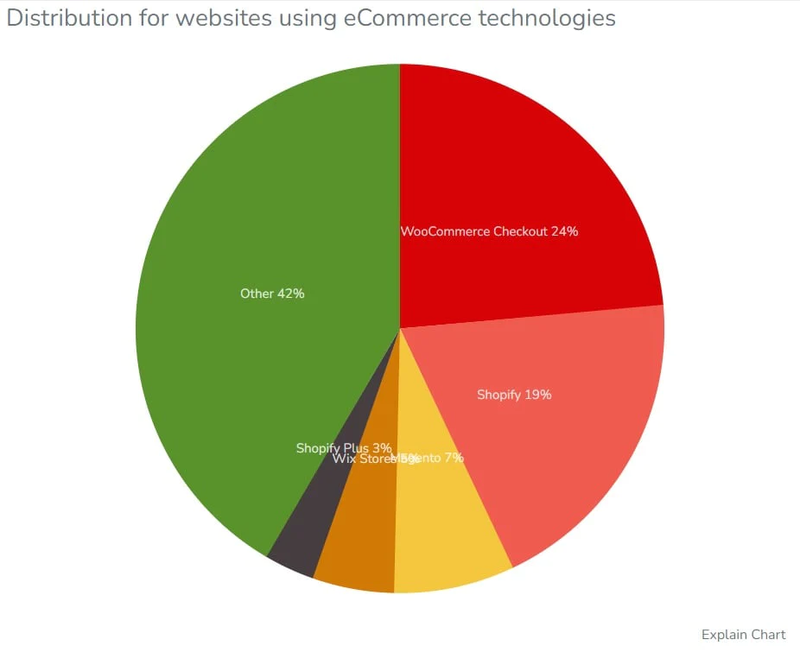
WooCommerce is currently the most popular choice for eCommerce websites, surpassing both Magento and Shopify in terms of market share. Data from the Distribution Chart of Websites Using E-commerce Technology below shows that WooCommerce has a 24% market share of the top 1 million websites by 2022.
If you want to build an eCommerce store , you must choose an eCommerce platform that will manage the payments and other features of your website.
Shopify is the most popular option out there. If you are just starting out, it will be harder to launch your online store with WooCommerce instead of Shopify. With WooCommerce, you need to have a hosted website as well as install WordPress. You will also need some coding knowledge or experience to set up and configure your store properly. In contrast, Shopify is much simpler and beginners can use it without any prior coding knowledge or experience.
In addition, the number of Shopify users is slowly catching up with WooCommerce in recent years. According to Buildwith, there are 4,147,766 live websites currently powered by Shopify.
The number of Shopify stores has grown by over 200% since 2020, with a 201.53% growth from March 2020 to January 2022 according to genes.ai . This is due to over 2.5 million new Shopify stores having been established in the past two years, during the Covid pandemic which has seen a large number of traditional offline retailers move their business online through Shopify.
Magento is one of the most popular e-commerce platforms out there and its success is due to its high level of availability as well as customization options. In addition, Magento has a team of innovators (more than 300,000 trained developers worldwide) who have created a powerful source of extensions that add various functions to online stores, helping them grow every year.
As of October 2022, approximately 163,590 active Online E-commerce websites are powered by Magento 1, and nearly 100,000 websites are powered by Magento 2, representing nearly 0.9% of all online stores worldwide. This is a remarkable statistic that confirms how large a commercial role Magento plays in the industry today compared to its competitors.
Magento is the third most popular choice for eCommerce websites and ranks behind WooCommerce and Shopify in terms of market share. The Website Delivery chart using e-commerce technology above shows Magento to have 7% market share of the top 1 million websites by 2022.
In the United States, there are 57,624 websites on Magento 1 and 34,863 websites on Magento 2, making the United States the country with the most websites using Magento, collected from Buildwith data. The second largest number of Magento website users comes from the United Kingdom, where there are 12,247 active websites on Magento 1 and 8,339 on Magento 2.
With Magento, you can easily build and customize your online selling platform to scale your business. With an intuitive interface and powerful features, this system is perfect for businesses of all sizes looking to take their online presence to the next level.
While Shopify, WooCommerce, and Magento are often best known in the eCommerce industry, they are not the only options. Some other popular platforms include Wix, Salesforce Commerce Cloud, BigCommerce, and Squarespace.
TrustRadius reports that each of these companies, with the exception of Squarespace, has a 12% market share of e-commerce platforms. Each platform has its own advantages and disadvantages, so it's best to research all the options before deciding which one is right for your business needs.
Squarespace was originally known as a website builder for beginners. However, it is quickly becoming a leading player in the e-commerce software market. It is estimated that 9% of businesses use the platform because it is user-friendly and offers unique eCommerce features such as great visualizable themes.
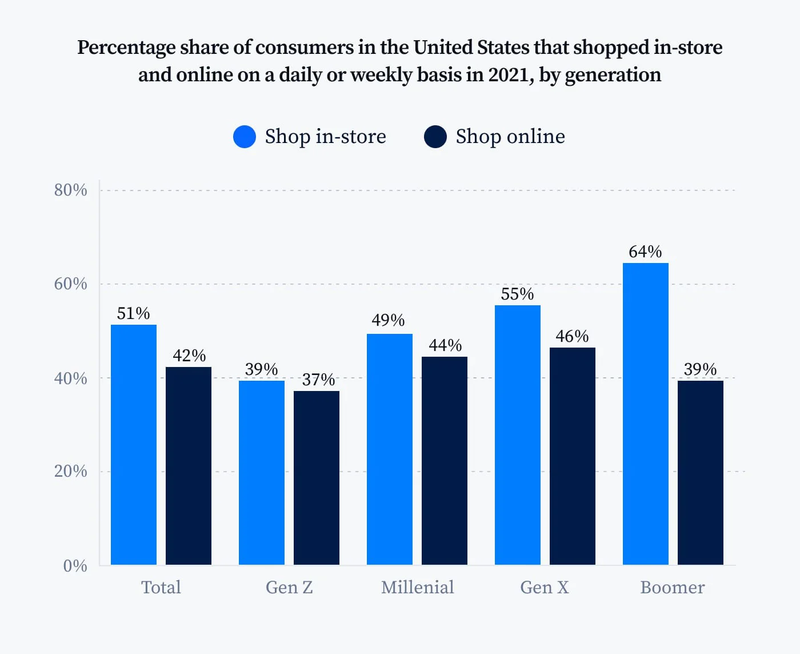
Tidio Research reports that when it comes to the eCommerce sector, Gen X online buyers remain the most relevant group of customers. They regularly shop online and have an average annual spend of nearly $70,000, which is higher than any other generation. Although their total cumulative spending power is lower than that of Baby Boomers, they make up for it by shopping online more often.
38% of people fear their credit cards are overloaded so Gen Z and Millennials instead choose to use debit cards when shopping. On the other hand, older generations prefer options such as credit cards or cash on delivery. Social media plays a major role in 35% of Millennial purchase decisions. Of all channels, social marketing is most effective for this demographic group.
This study has also found that about 45% of Gen Z customers refer to cross-pricing at multiple online stores to find the best deals. In contrast, Gen X and Baby Boomers are less likely to browse through multiple online stores than younger generations. This difference may be related to the fact that older generations have higher availability incomes and can afford to make purchases without hunting for bargains.
In addition, there is a clear correlation between gender and buyer behavior, which is most evident when considering the product categories most often purchased online. Women are more likely to buy fashion items and clothes (71% vs. 49% for men), while men are more interested in new technology-related products (49% vs. 31%).
According to a Trustpilot study from 2020, 89% of consumers globally take the time to read reviews before purchasing a product. This not only shows that reviews are an essential part of a buyer's decision-making process but also shows that buyers have high trust and confidence in the opinions of their peers.
As you probably know, potential customers weigh authenticity and transparency when reading reviews. Reviews with perfect scores can do more harm than good. In addition, eCommerce owners should avoid manipulating their reviews in any way, which includes censoring negative reviews. According to online review statistics from Trustpilot (2020), up to 62% of consumers say they would not support brands that participate in review moderation. This is a fact that can have harmful consequences for sales figures.
Although online reviews are not as strong as personal recommendations from family and friends, they still have a lot of influence on consumers. According to BrightLocal's latest online review statistics, nearly four in five (79%) consumers say they trust reviews they read online as well as personal recommendations (BrightLocal, 2020).
Sustainability is becoming increasingly important for consumers, with 54% considering it when making a purchase, according to Trivium Packaging . With the pandemic driving record deliveries in 2020 and 2021, there are now 6.3 billion tons of plastic waste globally.
With the world producing more and more inorganic waste every day, the sense of environmental protection is growing among consumers. 64% of shoppers in the US are now willing to spend more money on sustainable items.
One of the simplest ways to make your business more sustainable is to get rid of paper or harmful packaging materials to switch to biodegradable options. In-house product manufacturing allows you to better control what ingredients are used. By choosing environmentally friendly ingredients, you can make your brand more appealing to customers who focus on sustainability.
Here are some e-commerce statistics for 2022 that modern or future e-commerce sellers can refer to to get ready for 2023!
sellers Print-On-Demand are looking for products to do business on Amazon eBay, Etsy can contact Printway. Printway is one of the leaders in the field of print on demand with more than 500 + products and printers in Vietnam, China, USA, Australia, and Europe. Printway is ready to support you whenever you need us. Contact us today !
Reference source:
1, eCommerceDB, Ecommerce Shares in top product categories,https://ecommercedb.com/news/ecommerce-shares-in-top-product-categories/3649
2, manefest,(2022) Ecommerce Statistic For 2022: Growth and Trend to watch, https://magenest.com/en/ecommerce-statistics-2022/
3, Statista (2021),Most visited online retail websites worldwide in 2022, by monthly traffic, https://www.statista.com/statistics/274708/online-retail-and-auction-ranked-by-worldwide-audiences/