
Hanh Hoang
May 28 2026 •11 minutes
Selling print on demand on Amazon is one of the lowest-risk ways to launch a global apparel and accessory brand in 2026. You upload artwork, Amazon (or your supplier) prints and ships when an order comes in, and you keep a royalty - no upfront inventory, no warehouse, no shipping labels to print at midnight. But the model has evolved fast. Amazon's June 2026 update introduced a tier-based royalty system that rewards sellers who bring their own traffic, the product catalog has expanded beyond t-shirts, and the four largest English-speaking marketplaces - US, UK, Canada and Australia - now behave differently enough that a "one strategy fits all" approach leaves money on the table.
This guide walks through what print on demand on Amazon actually is in 2026, why it still works, how to start, and what's specific to each major marketplace. Where useful, we link out to deeper guides on the Printway blog so you can dive into individual steps.
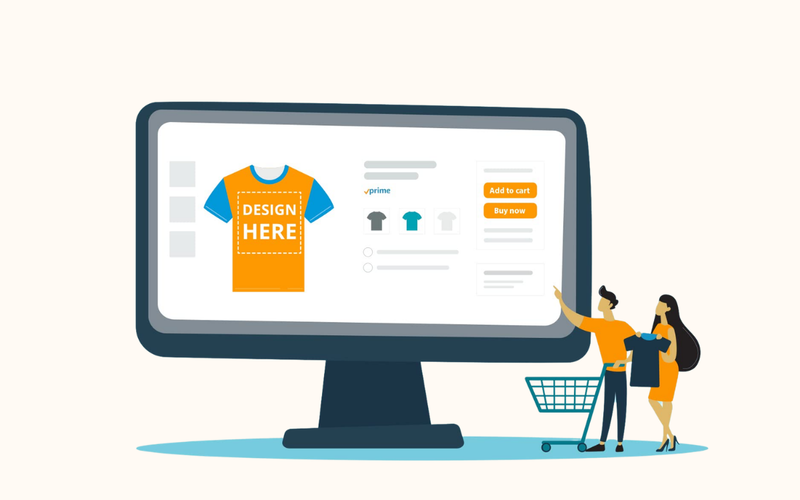
Print on demand (POD) on Amazon is a fulfillment model where products are manufactured only after a customer places an order. You create the design once, list it on Amazon, and when a sale comes in, the print partner - either Amazon itself or a third-party supplier - produces the item, packs it, and ships it directly to the buyer. You never touch inventory.
On Amazon specifically, sellers have two distinct paths to the same outcome:
Most serious sellers eventually use both: Merch on Demand for high-volume design tests and discoverability, Seller Central + a supplier like Printway for branded, higher-margin products that the Merch catalog doesn't support.
Amazon's traffic and trust are the short answer. Amazon captures roughly 38% of all US e-commerce sales in 2026 and remains the default product search engine in every market this guide covers. Listing on Amazon means tapping into hundreds of millions of buyers who arrive with their wallets already out - a very different funnel from Etsy, a Shopify store, or social commerce, where you have to manufacture the demand yourself.
A few specific reasons print on demand on Amazon is still one of the smartest plays in 2026:
The trade-off is competition. Apparel categories on Amazon are crowded, and 2026's policy that auto-deletes listings with no sales in 18 months means you can't just upload and forget. Sellers who win in 2026 treat Amazon POD as a real business: niche research, design quality, keyword-driven listings, and at least some external traffic to qualify for higher royalty tiers.
The short version of how to start print on demand on Amazon: get approved into Merch on Demand or open a Seller Central account, pick a supplier, research your niche, design product graphics, build the storefront and drive traffic. Below is a condensed walkthrough. For the full step-by-step playbook - including screenshots, supplier comparisons and ad templates - see our complete guide to selling print on demand on Amazon.
Head to merch.amazon.com, click Request invitation, sign in with an existing Amazon account, and complete the application. You'll need legal name and address, tax information (SSN for US individuals, EIN for US businesses, or W-8BEN for international applicants), and a bank account for royalty deposits. Amazon also asks a short set of questions about your design background and business intent. Approval typically takes between two and eight weeks in 2026, though some categories run faster. You don't need professional design credentials - Amazon evaluates intent and originality, not a portfolio.
If you'd rather skip the wait or want access to products outside the Merch catalog, open an Amazon Seller Central account instead. Seller Central approval is fast - usually same-week - and unlocks the much larger Amazon catalog.
If you went the Seller Central route, your supplier choice is the single biggest decision you'll make. The right supplier determines product quality, shipping speed, return rate and your margin. Evaluate suppliers on:
Printway operates fulfillment facilities across multiple regions and integrates directly with Amazon Seller Central, which is why a lot of our customers use us as their primary supplier when they go beyond the Merch on Demand catalog. Whichever supplier you pick, order samples before you list - you can't fix quality issues from a screenshot.
Open Amazon as a buyer and look at the niches you want to enter. Type a candidate keyword (e.g. funny dad fishing shirt) and study the top 20 results. Check the Best Sellers Rank (BSR), the number of reviews, the price range, the design quality and how saturated the niche looks. Use Helium 10, Jungle Scout or Merch Informer to validate search volume and competition density. In 2026, the winning approach is "narrow first" - go after micro-niches (a specific job + a specific hobby + a specific holiday) where you can rank without fighting 50,000 generic competitors.
For Merch on Demand, you're choosing from the 2026 catalog: standard tees, premium tees, long-sleeve, tank tops, pullover hoodies, zip hoodies, sweatshirts, PopSockets and phone cases. Per-unit royalty is highest on hoodies ($8–$13 on a $39.99 list price) and lowest on standard tees, but tees sell more volume - most sellers run both. For Seller Central + supplier, your range is much wider: mugs, posters, canvas prints, all-over-print apparel, blankets, pet items and seasonal categories like Christmas ornaments.
Design originality matters more than ever in 2026 - Amazon's IP enforcement is aggressive, and copycat takedowns are common. Use vector tools (Adobe Illustrator, Affinity Designer, Inkscape), keep transparent backgrounds, and follow each product's safe-print area guidelines. If you don't draw, hire on Fiverr or Upwork, or use AI generation tools - but always finalize the file yourself so you control the rights.
A storefront is no longer optional. In 2026, Brand Registry is the gateway to higher-converting product detail pages (A+ Content), Sponsored Brands ads, and a custom Storefront page that lives at amazon.com/yourbrand. You'll need a registered trademark in your selling country to enroll, but the lift is significant: A+ Content alone tends to lift conversion 8–15% on apparel listings. For each listing, write a title that front-loads your primary keyword, five bullet points that answer real buyer objections (sizing, fabric, occasion), and use all available image slots - lifestyle, flat lay, sizing chart, design close-up.
The June 2026 tier reset made external traffic a financial decision, not just a marketing one. Sellers who drive 15%+ of monthly units from outside Amazon (TikTok, Instagram, Pinterest, email, blog content, your own Shopify) qualify for the Plus tier - 2x royalties. Cross 35% and you hit Premium - 2.16x. In practice, the highest-leverage channels in 2026 are short-form video (TikTok and Instagram Reels showing the product in use), Pinterest for evergreen niches (gifts, weddings, faith, holidays), and Amazon's own Sponsored Products ads to defend your branded keywords.
That's the condensed version. For the full step-by-step - niche research templates, supplier comparison spreadsheet, listing optimization checklist and a 30-day launch plan - read our full guide here: printway.io/en/blogs/guide-to-selling-print-on-demand-on-amazon.
The same product can sell beautifully in one Amazon marketplace and flop in another. Fees, fulfillment speed, trending niches and even the dominant product types vary. Here's what to know about the four largest English-speaking markets in 2026.
Amazon US is the largest POD market on the planet and the default starting point. The 2026 Merch on Demand catalog is widest here (every product type available, including PopSockets and premium tees), royalty tiers apply in full, and FBA fulfillment is the fastest. Competition is fierce - expect to fight for visibility in mainstream niches like funny tees, pet, faith, fitness and patriotic categories. The winners in 2026 either go very niche or invest seriously in external traffic to hit Plus/Premium royalty tiers. A $19.99 t-shirt earns $2.44 at Creator, $4.88 at Plus, and $5.27 at Premium - the same listing, three different P&Ls.
For Seller Central sellers using a third-party supplier, the US is where Prime eligibility makes the biggest difference. Local printing inside the US (Printway's US facilities, for example) keeps you Prime-competitive and avoids the 5–8 day customs delays that hurt conversion on transatlantic POD.
The UK marketplace is the most mature outside the US and the easiest second market to enter from a US base, because there's no language localization required. The 2026 royalty change reframed UK earnings: royalties are now calculated on the post-VAT list price rather than the gross, which makes the numbers cleaner but means you'll see slightly different per-unit figures than the US equivalent. List prices skew lower than the US (UK shoppers are more price-sensitive on apparel), and demand is strongest for British-specific humor, football (soccer) niches, regional pride designs, and gift categories.
Local fulfillment matters even more in the UK because of post-Brexit customs friction on EU-printed goods. Suppliers with UK-based facilities ship next-day on Prime and avoid duties - which is why most serious UK POD sellers either use Merch on Demand or a supplier with local UK printing.
Canada is often overlooked but underrated. The marketplace is smaller (roughly 10–12% the size of Amazon US in 2026), but competition is correspondingly thinner, which makes it easier to rank a new listing. Sellers can extend US listings into Canada with one click via Amazon's North America Unified Account, with automatic CAD pricing.
The catch: most POD suppliers ship Canadian orders from the US, which incurs customs duties and adds 3–7 days transit. To run Prime-competitive in Canada, either use Merch on Demand (which fulfills locally where possible) or a supplier with Canadian production. Best-performing niches in 2026 lean toward outdoor and seasonal - winter sports, hockey, hunting, cottage life, regional Canadian pride.
Amazon Australia is the youngest marketplace in this guide and grew steadily through 2025–2026. The Merch on Demand catalog in Australia is narrower than in the US - primarily standard tees, hoodies, sweatshirts and tank tops as of 2026 - and minimum list prices for standard shirts rose roughly 8% in early 2026 due to local manufacturing cost shifts. Competition is the thinnest of the four marketplaces, which makes it an excellent place for new sellers to rank, but volumes are also smaller.
Local fulfillment is essentially mandatory in Australia. Shipping POD goods from the US to Australia is slow, expensive and tariff-heavy. Either use Merch on Demand or a supplier with Australian production - Printway operates AU fulfillment for exactly this reason. Niches that perform: surf and beach lifestyle, Aussie humor, footy (AFL/NRL teams), wildlife and travel themes targeting domestic and inbound tourism.
Do I need an LLC or registered business to start print on demand on Amazon? Not for Merch on Demand - individuals can apply with an SSN (US) or W-8BEN (international). For Seller Central, you can open a sole proprietor account and upgrade to a business account later. Most sellers form an LLC once monthly revenue passes $3,000–$5,000, primarily for liability separation and cleaner taxes.
How much money do I need to start print on demand on Amazon in 2026? Almost nothing for Merch on Demand - it's free to apply and you don't pay for production. For Seller Central + supplier, expect $40/month for a Professional Seller account, optional trademark fees ($250–$500 if you enroll in Brand Registry), $50–$150 for sample orders, and a small ad budget ($100–$300/month) to launch listings. Sub-$500 to start a serious business is realistic.
How long does it take to start earning? Most Merch on Demand sellers see their first sale within 2–6 weeks of being approved, assuming they upload at least 10–20 quality designs in researched niches. Reaching $1,000/month typically takes 4–9 months of consistent uploading, listing optimization and at least some external traffic.
What's better in 2026 - Amazon Merch on Demand or Seller Central with a POD supplier? Different jobs. Merch on Demand wins for fast design testing, frictionless setup, and built-in Amazon traffic on apparel/PopSockets. Seller Central + supplier wins for product variety (mugs, posters, home decor, all-over-print), branded packaging, and higher margins on premium products. Most established sellers use both: Merch on Demand for the apparel hits, Seller Central with a supplier like Printway for everything Merch doesn't offer.
Can I sell the same designs on multiple Amazon marketplaces? Yes. Amazon's North America Unified Account covers US, Canada and Mexico, and you can link UK and EU accounts under Global Selling. The same design can be listed in all marketplaces, but localize titles, bullet points and keywords for each country - cookout in the US is barbecue in the UK, sizing conventions differ, and seasonal demand peaks at different times.
Ready to go beyond the Merch on Demand catalog? Printway integrates directly with Amazon Seller Central and fulfills from facilities across the US, UK, EU and Australia - so your POD products ship locally, qualify for Prime, and arrive with the kind of quality that earns 5-star reviews. Read the full step-by-step guide or explore Printway's Amazon integration to get started.