
Hanh Hoang
Mar 04 2026 •13 minutes
Mother’s Day ecommerce strategy starts with understanding real search behavior across Google, Amazon, and Etsy. In this article, we break down key Mother’s Day search trends, Etsy keyword insights, and Amazon keyword data to reveal what shoppers are actually looking for-and how sellers can turn that demand into revenue. From product selection and SEO optimization to campaign timing and conversion tactics, this guide outlines actionable, data-backed steps to help e-commerce brands prepare early and win Mother’s Day 2026.
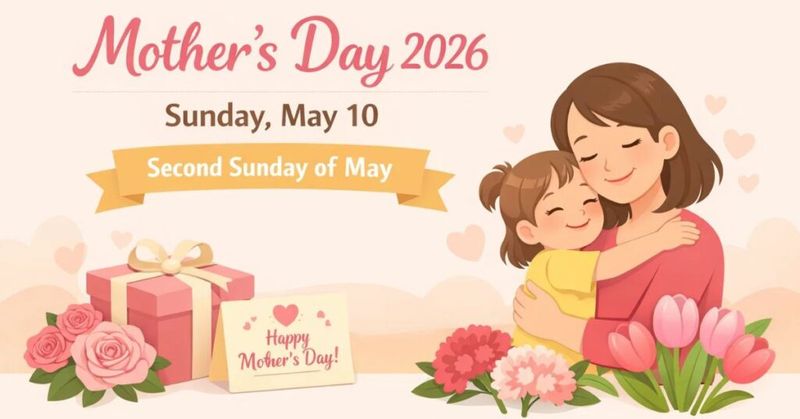
Before diving into specific data about Mother’s Day, it’s important for sellers to understand where it sits among the year’s major shopping events. Looking at U.S. holiday retail trends in Q1–Q2, Mother’s Day consistently ranks as one of the most significant seasonal spending moments-often outperforming other major holidays in the same period.
In the first half of the year, the primary consumer-driven holidays include:
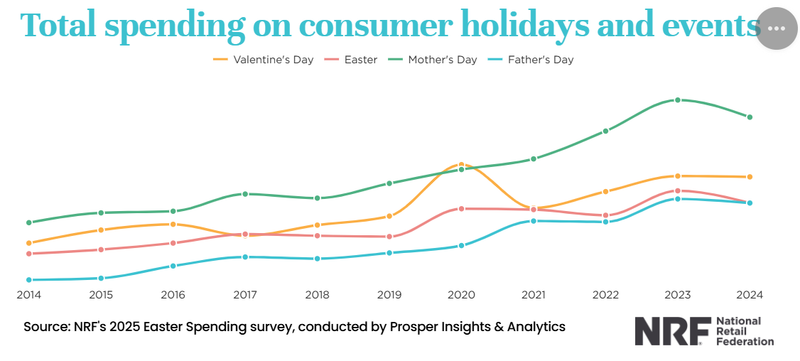
According to NRF survey data reflected in the chart, Mother’s Day consistently generates higher total consumer spending than Valentine’s Day, Easter, and even Father’s Day. The visual trendline clearly shows Mother’s Day leading among these holidays in most recent years.
The data shows several important patterns in U.S. shopping seasonality:
In 2025, 84% of U.S. adults (~270 million Americans) plan to celebrate Mother’s Day
This sustained growth reflects more than inflation - it signals expanding participation and higher per-person spending. Compared to other Q1–Q2 holidays, Mother’s Day demonstrates stronger resilience and broader consumer engagement.
For sellers tracking seasonal ecommerce trends, this makes Mother’s Day a cornerstone event in the U.S. holiday retail schedule.
Several factors explain why Mother’s Day continues to gain importance:
For ecommerce sellers, Mother’s Day is not just another seasonal event-it is a major revenue-driving holiday positioned at the end of Q2’s peak gifting cycle. Brands that align inventory planning, SEO, advertising, and promotional timing with this upward spending trajectory are better positioned to capture demand in 2026.
In the context of shopping seasonality, Mother’s Day stands as one of the most reliable and scalable revenue opportunities in the U.S. retail calendar.
Analyzing historical spending patterns from 2025 helps brands anticipate where consumers will allocate their budgets in 2026. Based on the latest Mother’s Day spending statistics, 2025 remained near record-breaking levels, reinforcing Mother’s Day as one of the most powerful seasonal revenue drivers in the U.S. retail calendar
The 2025 data highlights strong, stable consumer demand and provides valuable signals for the Mother’s Day retail forecast heading into 2026.
Consumer sentiment remains strong:
This means nearly 94% of consumers are maintaining or increasing spending levels, signaling stability and resilience in holiday budgets.
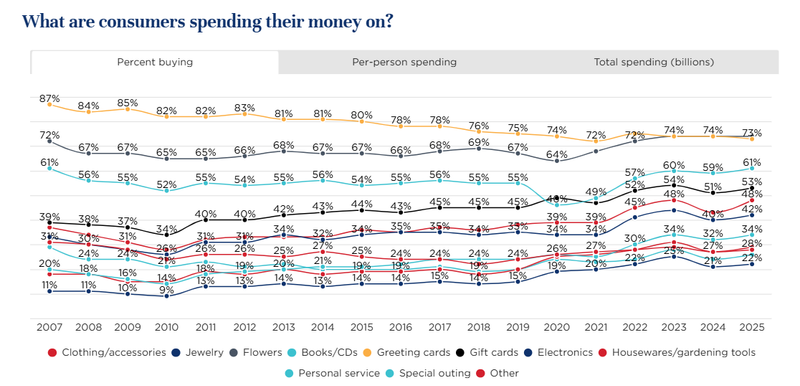
The spending curve from 2007 to 2025 shows:
For 2026, this suggests spending is likely to remain elevated rather than decline sharply.
While specific category totals vary, Mother’s Day spending typically distributes across:
The data suggests a growing shift toward:
The 2025 Mother’s Day spending statistics reveal three major insights for ecommerce brands:
Millennials drive premium demand – Personalized and experience-style products are especially attractive.
For 2026, sellers should prepare for continued strong demand by:
Based on current data, the Mother’s Day retail forecast for 2026 remains optimistic, making early preparation a competitive advantage for ecommerce brands.
Data around how people celebrate Mother’s Day provides insight into what kinds of products they are likely to buy. Based on recent Mother’s Day gift shopping patterns, consumers are not only spending more but also placing greater emphasis on meaningful, memory-driven gifts and celebration experiences.
Mother’s Day is a widely anticipated holiday, and planning behavior reflects strong purchase intent:
Source: NRF
Understanding celebration planning behavior helps sellers align products with how consumers actually celebrate:
Top gift categories in 2025:
Experience-driven gifting: Many shoppers combine physical gifts with outings, such as brunch or family gatherings, increasing demand for gift bundles and add-ons.
Desire for uniqueness:
This signals strong opportunity for personalized products, storytelling-based designs, and custom POD items.
Cross-selling opportunities:
For ecommerce sellers, Mother’s Day is not just about single-item purchases-it’s about helping customers create a complete celebration experience. Brands that position products as part of a meaningful moment rather than just a standalone item are more aligned with evolving Mother’s Day purchasing behavior.
Knowing who buys gifts and who they’re buying for is critical for targeted marketing and segmentation. Recent Mother’s Day recipient data and consumer demographic insights reveal clear patterns in who celebrates, who receives gifts, and where sellers should focus their efforts for 2026.
Mother’s Day participation remains high, with over 80% of adults celebrating. Key demographic insights include:
Celebrators are more likely to be male, married, and have children.
Participation is highest among Gen Z and Millennials, making them core target segments.
African American, Asian, and Hispanic groups show higher likelihood to celebrate compared to average.
Non-celebrators tend to be older (average age near 60), divorced, separated, or widowed, and more likely to live in rural areas.
In terms of recipients:
Smaller percentages buy for other relatives or godmothers
Among those celebrating, the average shopper buys for 1.4 recipients, with many purchasing for more than one person-creating strong upsell and bundle opportunities.
Spending also varies by generation, with Millennials among the highest spenders, reinforcing their importance for premium and personalized product positioning.
From a segmentation perspective, the data highlights several strategic opportunities:
Purchase motivations:
Over two-thirds look to retailers for gift inspiration
For ecommerce sellers, this means:
Understanding these consumer demographic insights allows brands to refine targeting, messaging, and product strategy ahead of Mother’s Day 2026.
A closer look at 2025 activity and marketing data reveals clear patterns in experience-driven gifting, shopping timelines, and ecommerce performance.
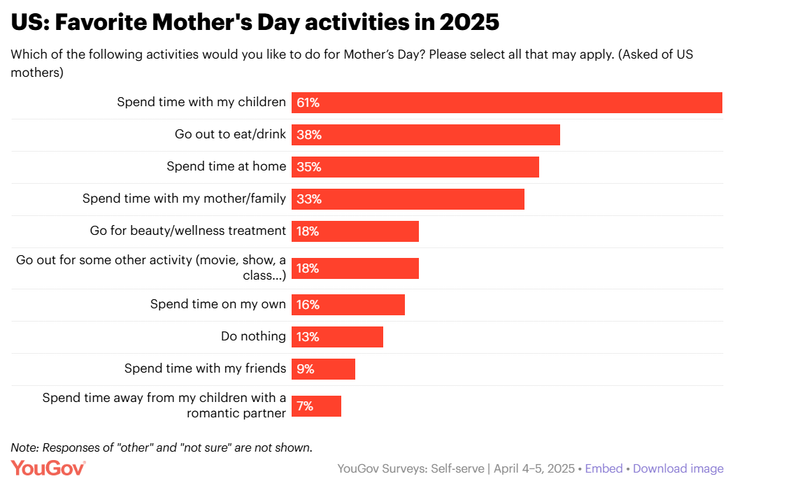
Beyond gifts, activities associated with Mother’s Day influence how consumers shop and spend. 2025 Mother’s Day celebration activities highlight a strong shift toward family time and experience-driven moments.
Consumers increasingly combine physical gifts with experiences (e.g., flowers + brunch, personalized keepsake + family dinner).
Sellers should bundle products with “moment-based” positioning (memory gifts, matching family items, celebration kits).
A quick recap of key Mother’s Day marketing statistics helps sellers identify where to focus for 2026.
Conversion & strategy insights:
Where sellers should focus first:
These Mother’s Day ecommerce data insights confirm that early planning, personalization, and experience-driven marketing will be key for 2026 success.
Search behavior is often the earliest indicator of trend shifts and purchase intent - especially for gift occasions like Mother’s Day.
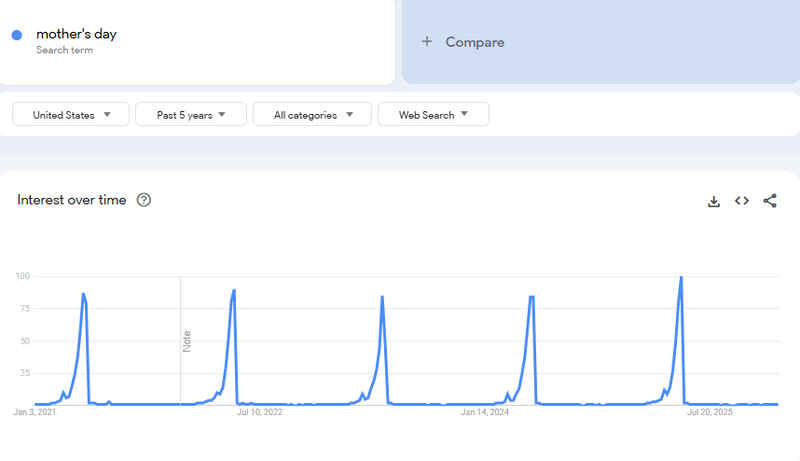
Analyzing Mother’s Day search trends on Google provides early signals of purchase intent and helps sellers optimize campaign timing, SEO, and ad spend ahead of peak demand.
For 2026, brands should begin SEO optimization and campaign launches at least 3–4 weeks early, while reserving budget for high-conversion, last-minute search spikes in early May.
Etsy search data shows that Mother’s Day gift–related keywords spike sharply from late April to early May, aligning with peak buying intent. For sellers, understanding high-volume and niche search terms is critical to optimizing visibility and conversions during this seasonal window.
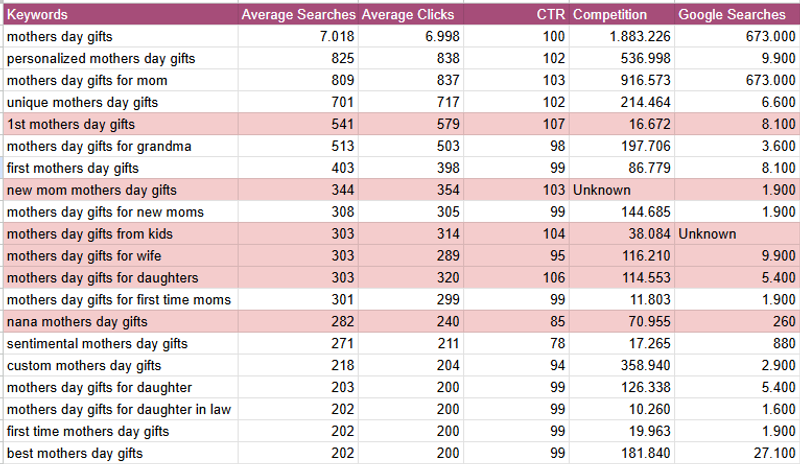
High-volume Etsy search terms (by average searches):
These broad keywords indicate strong demand for both personalized items and emotional-expression products such as cards, shirts, and custom keepsakes.
Niche & recipient-focused keywords with strong potential:
These long-tail keywords often show lower competition and strong CTR, making them highly attractive for smaller or newer Etsy shops looking to rank organically.
Based on Etsy keyword trends:
Overall, Etsy data confirms that personalized, recipient-specific, and emotionally driven gifts dominate search behavior, creating strong opportunities for POD and handmade sellers preparing for Mother’s Day 2026.
Amazon FBA keyword data reveals strong Mother’s Day search trends driven by high-revenue jewelry and gift-related queries. The top-performing terms by monthly sales include “mother’s day gift,” “mother’s day jewelry,” and “mother’s day necklace,” with peak performance in May.
Recipient-Specific Intent: High-converting long-tail keywords include:
Emerging Niche Trends: “mother’s day funny” shows a strong 90-day growth trend (+276), alongside “meaningful mother’s day gifts.”
Misspelled & Punctuation Variations: Variations and typographical errors still rank among top search terms - highlighting optimization opportunities in backend search terms.
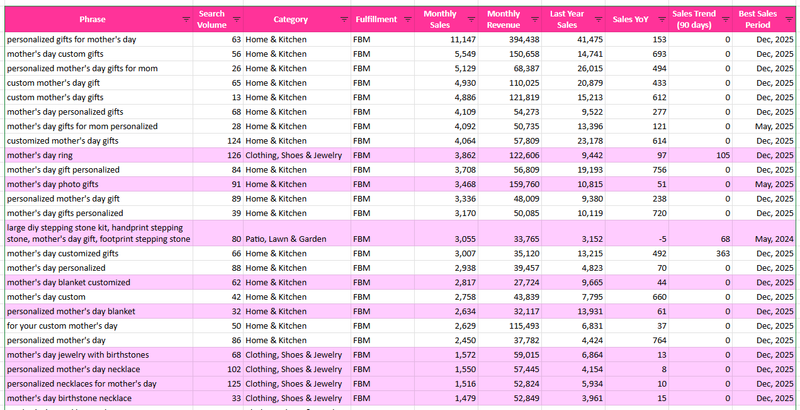
Amazon FBM / Merchant Fulfilled data shows a stronger concentration on personalized Mother’s Day gifts and custom products compared to FBA.
Top Performing Keyword Cluster: “personalized gifts for mother’s day” “custom mother’s day gifts” “personalized mother’s day gifts”
High-Demand Product Types:
Leading Categories: Home & Kitchen, Clothing, Shoes & Jewelry, Patio, Lawn & Garden
FBM sellers appear to compete strongly in custom, made-to-order, and home décor segments, especially products that allow personalization (names, photos, messages).
Using the data above, here’s how e-commerce sellers can prepare a winning strategy for Mother’s Day 2026.
Using the data above, here’s how e-commerce sellers can prepare a winning strategy for Mother’s Day 2026. Leveraging real Mother’s Day search trends from Google, Etsy keyword insights, and Amazon keyword data, sellers can align product development, SEO, and promotions with proven buyer behavior.
Trending product categories Data shows consistent demand in Jewelry (especially necklaces), Home & Kitchen, Clothing, Beauty & Personal Care, and personalized home décor. High-revenue items like mother’s day jewelry and customized keepsakes should anchor your seasonal catalog.
Personalization & gift bundles Across Amazon (FBM) and Etsy, “personalized” and “custom” terms dominate. Offer:
Inventory planning FBA sellers should secure inventory early for top SKUs (jewelry, giftable items) before April spikes. FBM and handmade sellers should prepare production capacity for personalized orders, as demand surges in late April and early May.
Keyword targeting plan (Google, Amazon, Etsy)
Title & listing optimization
PPC & advertising timing Start testing campaigns 4–6 weeks before Mother’s Day. Increase budgets during peak search windows (late April–early May). Shift ad messaging from “gift ideas” early on to “last-minute Mother’s Day gifts” closer to the deadline.
When to launch campaigns
Peak search windows to target Search interest spikes sharply in late April and continues into early May. Plan inventory, ads, and email reminders to align with this surge.
Event-based promotions
Strategic seasonal selling tips like urgency messaging and delivery cut-off reminders significantly improve conversion rates.
Email automation Set up flows for:
Segment audiences by past buyers (jewelry buyers, home décor buyers, etc.).
Upselling bundles Offer complementary add-ons (gift wrap, greeting cards, matching items). Bundles increase perceived value and raise average order value.
Post-purchase lifetime value focus Use Mother’s Day buyers to build long-term retention:
A strong Mother’s Day ecommerce strategy should prioritize both seasonal revenue and long-term customer growth.
Mother’s Day 2026 insight clearly shows recurring patterns: personalization wins, recipient-specific targeting converts, and emotional gifting drives revenue. Sellers who align product, SEO, and timing with data-backed trends will not only capture peak seasonal demand but also strengthen long-term brand growth.
The opportunity is predictable. The advantage goes to those who prepare now.
>>> See more suggestions & trends for Mother's Day in our Ebook